1940s – 1960s
From Golf Course to Classroom: The Early Years
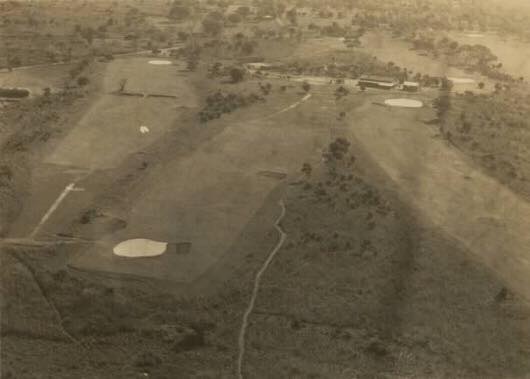
Bishop Mackenzie began in 1944 with 12 students and one teacher at the Lilongwe Golf Club, and has since grown into a diverse school welcoming students from many backgrounds and nationalities.
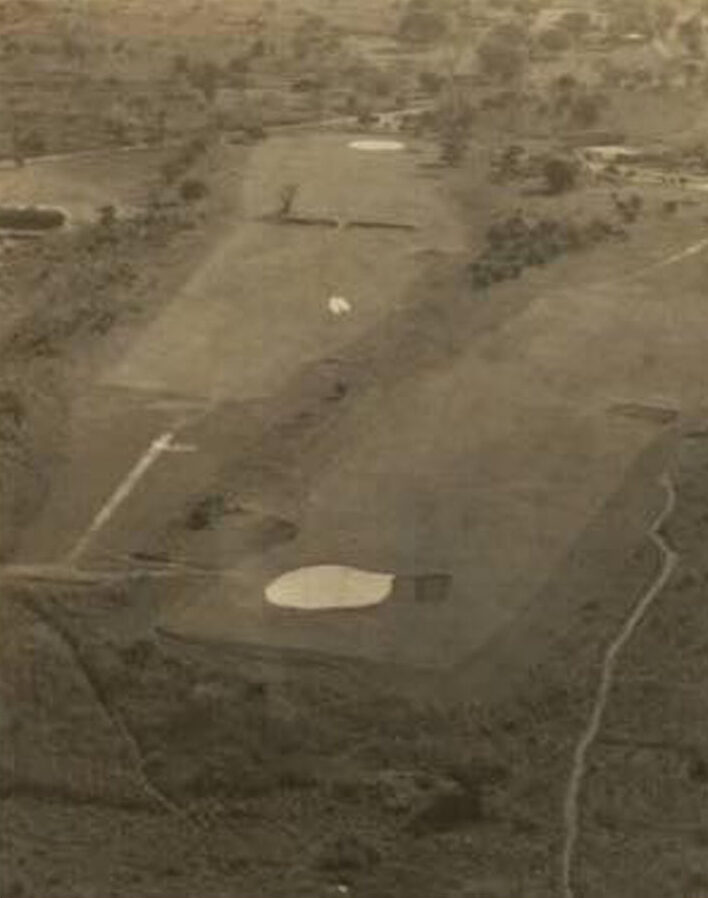
Birds-eye view of Lilongwe Golf Club in the 1940s.
Image courtesy of: The Mbabzi Story: Celebrating 100 Years in Malawi, Alexandra Barron.
While the school’s official founding was in 1944, its roots extend further back to the 1930s. The story begins with a unique act of love. Arthur Falconer (A.F.) Baron built the Lilongwe Golf Club as a wedding present for his wife, Marjorie in the 1930s. Prior to meeting Marjorie, A.F. had never played golf, but Marjorie was a keen golfer, so A.F followed in her footsteps and took lessons in England. He enjoyed it so much that he bought the land from the government and built a 9-hole golf course with sand greens.
First tobacco farm in Malawi.
Image courtesy of: The Mbabzi Story:
Celebrating 100 Years in Malawi, Alexandra Barron.
What started as a personal passion project blossomed into a thriving recreational space and social hub for the European community in Lilongwe. In the following years, tennis courts were built, and after the war, playing fields were also added to the development.
Extracted from The Mitre. Sascha Harper Kent, Year 5L, (1986, p.7):
“In 1952, this school was called Lilongwe European School. It used to be at the Golf Club in Lilongwe. The school had only one teacher named Miss Fairly, who, when she got married, re-named herself to Mrs. Marks. Then the school was removed from the Golf Club to where it is now. There the Ministry of Education took on another teacher whose name was Miss Condon. She became married and was called Mrs. Brown.
These were all the classes they had:
Sub A and Sub B which is the same as Std. 1 and Std. 2 now and Standards 1, 2, 3, 4, and 5.
Excerpt from The Mitre (Bishop Mackenzie School yearbook), 1985.
Cont. extract from The Mitre. Sascha Harper Kent, Year 5L, (1986, p.7):
When there were 38 children in the school a second teacher was enrolled. She was Mrs. Robertson’s mum, Mrs. Ingram.
The children wore a different uniform from what we wear today. The boys wore khaki shorts and a shirt and a blue and white striped tie. The girls wore blue dresses and grey felt hats.
Then the hostel was built. At first it only had 14 boarders. It was in Room 4C. The first matron was called Mrs. Gurney. Her husband was the official crocodile hunter. The original school building was where the office now is and where the two Standard 5s and computer room are.
The fees were much cheaper then. It was different money too. It was £3.15s per term.”
Cont. extract from The Mitre. Sascha Harper Kent, Year 5L, (1986, p.7):
That is about K8. Now it is K510 per term!
I think the talk was very interesting. I liked the part about the official crocodile hunter’s wife. The matron and the Headmistress often had very bad arguments. They had phones and they would phone each other up. The pupils had to answer the phone and take the messages because they didn’t want to talk to each other.
I’m happier to be here now because I like modern days better. I like lots of teachers and lots of children and I like the present name of the school better.
I think we’re lucky to have a pupil of the school in 1952 to be a teacher now and come and talk to us. It is 33 years since Mrs. Robertson was a pupil. Supposing I came back to this school in 33 years time, it would be the year 2018. I wonder what I would see? Probably a lot of changes.
From Golf Course to Classroom: The Early Years
Bishop Mackenzie International School is a cornerstone of education in Malawi and has a rich history deeply intertwined with Malawi’s development over the course of 80 years!
While the school's official founding was in 1944, its roots extend further back to the 1930s. The story begins with a unique act of love. Arthur Falconer (A.F.) Baron built the Lilongwe Golf Club as a wedding present for his wife, Marjorie in the 1930s. Prior to meeting Marjorie, A.F. had never played golf, but Marjorie was a keen golfer, so A.F followed in her footsteps and took lessons in England. He enjoyed it so much that he bought the land from the government and built a 9-hole golf course with sand greens.
What started as a personal passion project blossomed into a thriving recreational space and social hub for the European community in Lilongwe. In the following years, tennis courts were built, and after the war, playing fields were also added to the development.
Extracted from The Mitre. Sascha Harper Kent, Year 5L, (1986, p.7):
“In 1952, this school was called Lilongwe European School. It used to be at the Golf Club in Lilongwe. The school had only one teacher named Miss Fairly, who, when she got married, re-named herself to Mrs. Marks. Then the school was removed from the Golf Club to where it is now. There the Ministry of Education took on another teacher whose name was Miss Condon. She became married and was called Mrs. Brown.
These were all the classes they had:
Sub A and Sub B which is the same as Std. 1 and Std. 2 now and Standards 1, 2, 3, 4, and 5.
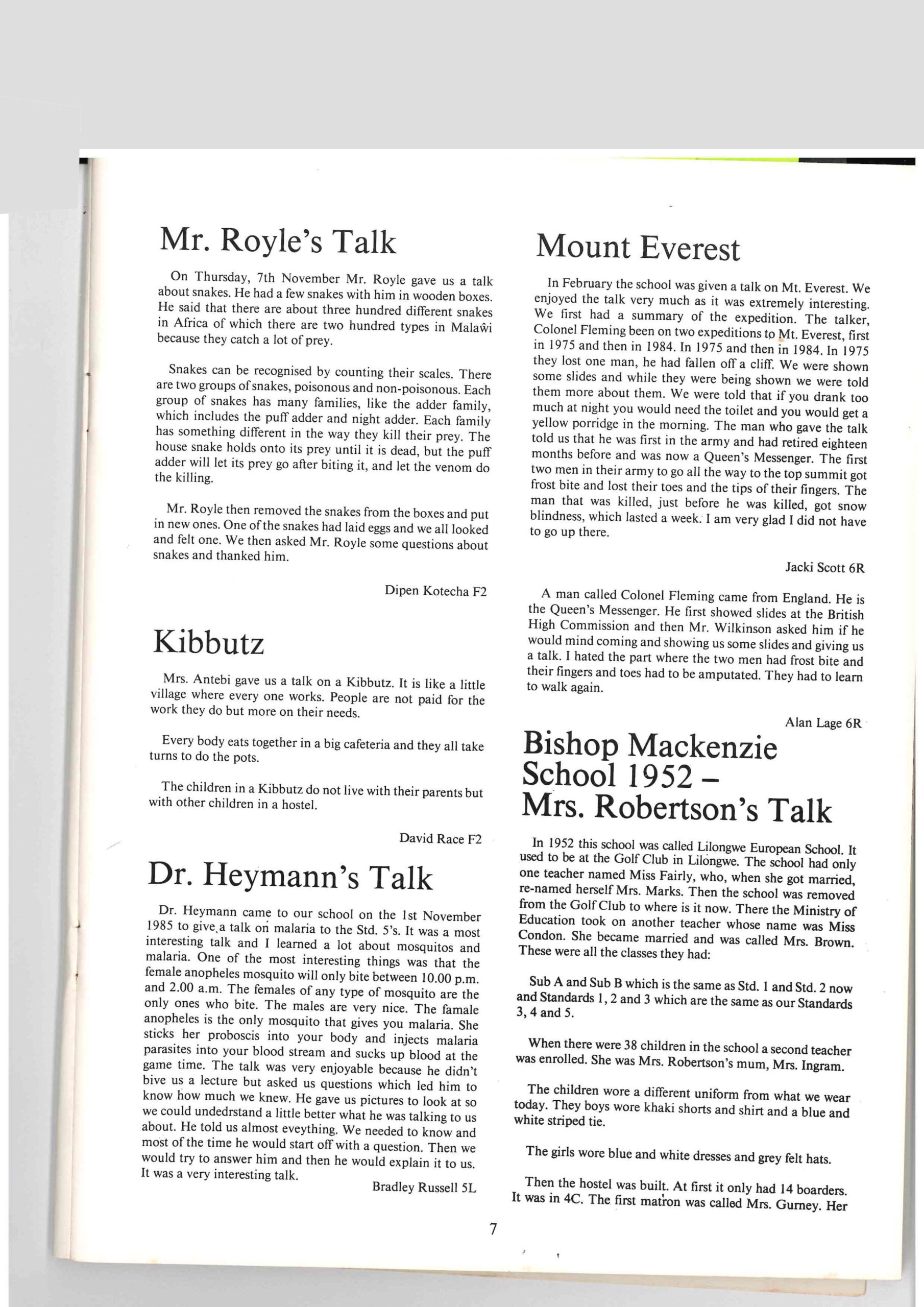
Excerpt from The Mitre (Bishop Mackenzie School yearbook), 1985.
Cont. extract from The Mitre. Sascha Harper Kent, Year 5L, (1986, p.7):
When there were 38 children in the school a second teacher was enrolled. She was Mrs. Robertson’s mum, Mrs. Ingram.
The children wore a different uniform from what we wear today. The boys wore khaki shorts and a shirt and a blue and white striped tie. The girls wore blue dresses and grey felt hats.
Then the hostel was built. At first it only had 14 boarders. It was in Room 4C. The first matron was called Mrs. Gurney. Her husband was the official crocodile hunter. The original school building was where the office now is and where the two Standard 5s and computer room are.
The fees were much cheaper then. It was different money too. It was £3.15s per term.”
That is about K8. Now it is K510 per term!
I think the talk was very interesting. I liked the part about the official crocodile hunter’s wife. The matron and the Headmistress often had very bad arguments. They had phones and they would phone each other up. The pupils had to answer the phone and take the messages because they didn’t want to talk to each other.
I’m happier to be here now because I like modern days better. I like lots of teachers and lots of children and I like the present name of the school better.
I think we’re lucky to have a pupil of the school in 1952 to be a teacher now and come and talk to us. It is 33 years since Mrs. Robertson was a pupil. Supposing I came back to this school in 33 years time, it would be the year 2018. I wonder what I would see? Probably a lot of changes.