- Please introduce yourself, with your name and the years you were a student at Bishop Mackenzie International School.
I’m pleased to be able to participate in this legacy project. You know, I didn’t realise that the Lilongwe School was that old, that it started back in 1944 during the war. That is quite something.
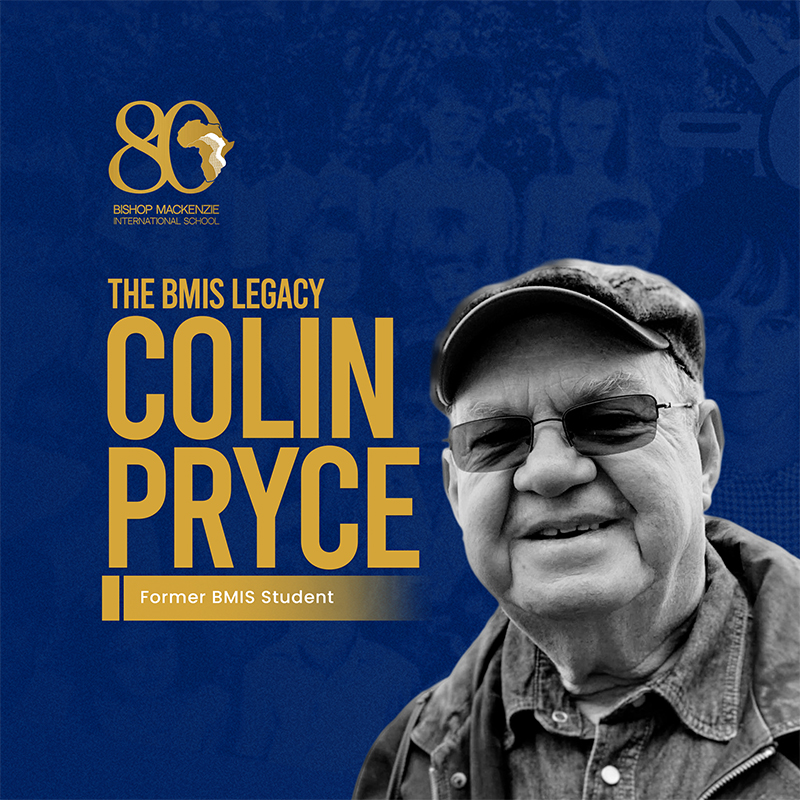
My name is Colin Pryce.
We were living in Lilongwe, and I started as a student at Lilongwe European school, as it was known back then. It had already moved from the golf course to its present site when I started in 1953. I attended the first two years there and then due to a fallout between a lot of parents and the head teacher who was very unliked, some of us moved to Fort Jameson School for a couple of years. The Federal Federation of Rhodesia and the Nyasaland Education Department revamped the school and changed the head teacher, and then we all went back in 1957. I continued there up until I completed the last year – Standard 5, in 1960.
I then left for high school in Blantyre at Saint Andrews High School where I stayed up until 1963. Then, with the breakup of the Federation and the change of politics as Nyasaland became Malawi, my father gave way to allow the Africanisation of the company he was working for, AP & MB (Agricultural Production and Marketing Board), before it became what is now ADMARC (Agricultural Development and Marketing Corporation). So, we moved to Rhodesia, where I finished my high schooling at Sinoia High School. I then went on to do my formal education at the Gwebi College of Agriculture, just north of what is now Harare.
- What brought you to the school? What influenced you to come to Malawi?
I was born in Cape Town, South Africa in 1948. A long, long, long time ago. The advent of the change of politics seemed to be a recurring theme in my life. Following the change of politics in South Africa, when the National Party came into power, my father didn’t want anything to do with that, and he had a sister living in Limbe at the time who was married to a man working for the Nyasaland Railways. So, my aunt came down to Cape Town on holiday and said that they were looking for some tobacco supervisors for the Native Tobacco Board, as it was called then. My father applied, and he got the job.
So, we embarked on a five-day steam train journey from Cape Town to Limbe. We arrived filthy, dirty, having travelled all the way through the whole of southern Africa!
We then took an overnight train from Limbe to Salima. Finally, we took what was a two-to-three-hour long car journey in those days, from Salima to Lilongwe. We ended up in in the Central Province, as it was called then, at a tobacco station called Chileka which was on the Mchinji road, just near Namitete. So, that was our first home. No electricity, no water, no phone, no tar road, toilet outside, kitchen outside. My father didn’t even have a car then, he was doing his supervision work with the farmers growing tobacco, groundnuts, and maize, and so on, on a bicycle.
So, we stayed there for three years until we got our first long leave. When we came back from the leave, we were stationed at Malangalanga, the provincial headquarters of what then became the African Tobacco Board. During that time, it then became known as the Farmers Marketing Board. There was social awareness around the changing of the name from Native Tobacco Board to African Tobacco Board to Farmers Tobacco Board, as they were becoming more and more politically correct with the name.
While we were at Malangalanga, I started school at the Lilongwe School as a day scholar in kindergarten. Kindergarten was called Sub A and Sub B or Kindergarten 1 and Kindergarten 2. I then went up to Standard 1 and Standard 2, and all the way up to Standard 5.
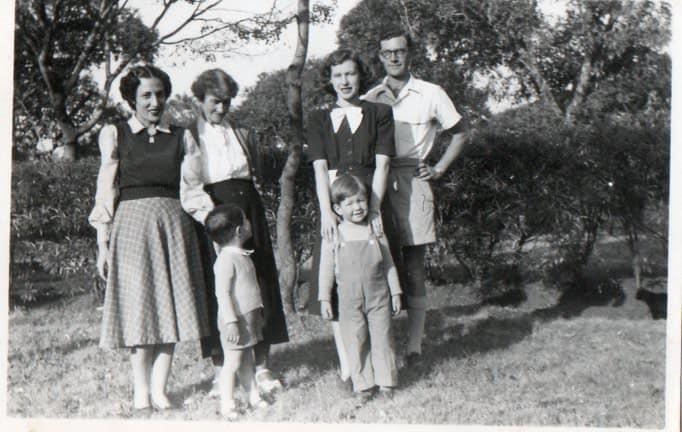
Figure 1: Here’s a photo of Nyassa Bessone and Julian with me and my mother and father Joan and Reg Pryce. I don’t know who the other lady next to Nyassa is. The photo was taken at the Chileka ADMARC market, near Namitete, where we lived in 1950/53.
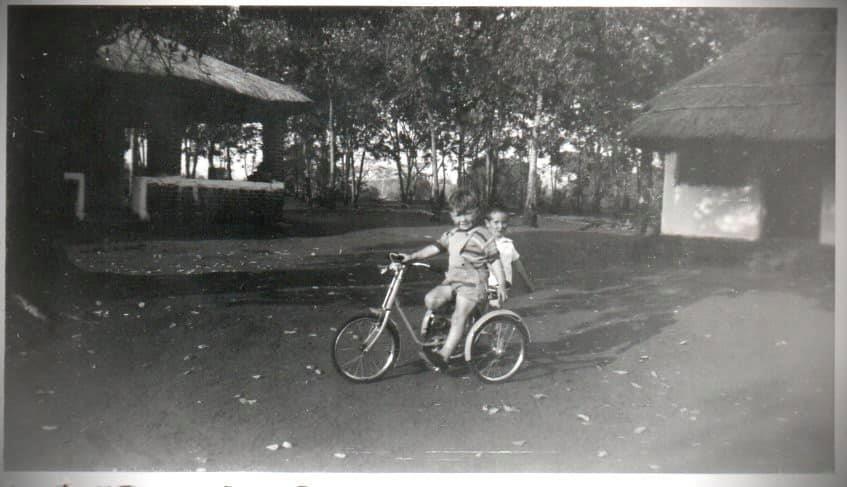
Figure 2: Here’s a photo of Nyassa Bessone and Julian with me and my mother and father Joan and Reg Pryce.
After three years, we took another long leave and when we came back, we were stationed out in Mpingu, which was on the same road as Chileka, but just past the Chitedze Research Station on the Mchinji road. Believe it or not, we were only 14 miles away from Lilongwe, but I became a boarder because of the bad road conditions, and during the rains, there were times when you couldn’t even get through. I was a boarder and yet my parents lived 14 miles away from the school! So, that is how I came to be at the Lilongwe School.
I am now living in Belgium with my Belgian wife, in the East, in the Ardens. It’s very beautiful here, very green and wet at the moment, very cool for summer. I last visited Malawi in 1996. I was living in Tanzania at the time and I was working at UNHCR, the UN Refugee Agency dealing with the unfortunate Rwandan genocide. We visited Malawi and went to Lilongwe, and visited Malangalanga, and actually visited Bishop Mackenzie too. It was during the school holiday, so there was nobody there at the time. But we walked around, and it was very interesting to see the old original classroom block and administration block still there! I saw the small concrete quad or square in front of the steps, up to what was the original school hall and said to my wife, “believe it or not, but the whole school stood on this little square of concrete”. As adults visiting the school, I couldn’t believe that it was such a small square. But there were very few pupils during my time, I would say 60 or 70 in total, for the whole school.
I like to travel the world and my old places on Google Earth, so I check on Bishop Mackenzie School every now and then to see how it is developing. All of our previous homes are still there, believe it or not. Except for the Chileka one. It was an old, thatched building that is now long gone, and there is now a modern house there for the new supervisor (I don’t know what they call them now) of the buying station, for ADMARC.
- Were there any significant changes at the school during your time?
It’s amazing to see how Bishop Mackenzie has developed. There was a development whilst I was a student there, of a new school block that was built behind the original block. I think there were two classrooms there. Just after I left for St. Andrews, finally, after years and years of raising funds for a swimming pool, a new swimming pool was built. It was just a miniature pool, but that pool was basically built with fundraising by the parents of the school. That was quite a day, the launch of the new swimming pool! My sister enjoyed that. She also went to the Lilongwe School for a while and saw that part of the development of the school.
I participated in the renaming ceremony of the school and was chosen to read a passage of the Bible, one verse. Several of us as seniors, and I think even some juniors, participated physically – reading parts of the ceremony. That was a big day for the school, when it had its own name.
- Do you remember why they changed the name of the school to Bishop Mackenzie?
Well for a start, this was 1963, if I remember correctly. The Lilongwe European school did not ring well, and the school was not really a European School. They could see winds of change were blowing in Africa at the time, so obviously the school had to mature. It had to grow up and become a school with its own name. So, they decided to recognize Bishop Mackenzie who was an important figure in the early days of David Livingstone, and so on, in the ending of the slave trade, and so on. There was very little recognition of him in Nyasaland at the time. So, I think that was all part of it. That this new name was in memorial of him. I don’t know if the school has any memory of, you know, sort of memorial for him, annual memorial of his death or anything like that or not.
- What was life as a student like during your time? Tell us about your day-to-day life, from what you remember. How diverse was the school body? How was your class structured? What was boarding school life like? And school holidays? Tell us about that as well.
Well firstly, I thoroughly enjoyed school at the time. It was a fairly free and easy education. It wasn’t strict, like it is nowadays, in comparison to my children’s experience going through schools, there wasn’t as much pressure.
My record at school was that I regularly came second in class in the school exams. There was one girl, Stevie Ambrose, she always came first. There was a friendly battle between the two of us, but it was not such a big deal. Life was good. My sister was not so happy. She was okay, enjoyed school, but didn’t like being a boarder. She missed home life. There was a four year difference between the two of us, so I was there for some time before she joined.
I think the tree might still be there, but there was a tree just inside the gate at the end of the long road, coming down from the Likuni roundabout. There was a big tree in front of what was the school hostel. Well, my sister, every day, every weekend we were allowed on either Saturday or Sunday and my sister would be standing under that tree waiting for our car to see the car coming down. During the term, we would have exit weekends during long weekends.
We first had four terms a year. They were fairly short, and we had short-ish holidays. Christmas holida ys were always slightly longer, but then that changed when the Federation came in. When the Federation was introduced, there were three terms a year, and there were longer school holidays.
At school we would have sports. The main sports for the boys were cricket and football; and for the girls it was netball and hockey. There was also athletics which we all participated in. We used to play sports against other schools including the Lilongwe Asian School. Especially cricket and hockey. They always used to beat us. They were so good at those two sports!
We used to also have scouts and boy cubs, and brownies. As you can see from the photos, that was quite multiracial. We had our own scout or cub groups at school. We would have weekends or days where we would participate with other groups in the area and from Nkhoma. The woman in charge of the girl guides was a missionary from Nkhoma – which was in the Protestant Mission. She would drive in all the way from the Dedza area. We had a good relationship with others in the area through these activities, even though as the name of the school suggests – we were all European. But we had Portuguese, we had Italians, there were Americans, Canadians. There were children from missionary families. The majority of us, I think, were from families working for the government in the police, PWD, Veterinary Department, Agriculture Department, scattered all over Nyasaland. Then of course, there were the business people of Lilongwe who also sent their children there, as well as missionaries from various parts.
As boarders coming from different parts of Nyasaland… Because of the poor road conditions, the Central African Airways had the Dakota and Beaver Aircraft flying to Salima, to Mzimba, to Mzuzu, to Karonga, mainly to the North. The highlight of that was that they had to fit in their travel with the school timetable, and the timetables didn’t always necessarily enable them to fly on the last day of school. They would often fly one or two days before the end of school and I always thought that was great, because I would actually have two days short of the term. And that was a big deal, that “I’m leaving before you” and so on. And that was how our small lives were, small things that we appreciate, because in those days there was no television. We used to get books from the Times bookshop, read the American comics of Dell and all the British Dandy and Beano comics which would be sent out by AMO. We would then share these around and that was our sort of reading material.
The holidays were nearly always at least a week down to Salima, to the lake shore. That was the highlight of the holidays – going to swim in our own ocean, Malawi’s own ocean. Those were wonderful times. We would stay, not necessarily in the hotels, but in some of the company cottages that were dotted away along the lakeshore. Then others would go up to the Nyika Plateau or down to Blantyre, Mulanje. Due to the poor travelling conditions, we basically stayed close to home not going too far. Salima was connected to Lilongwe eventually with a narrow 9-foot wide road winding through the hills. That was the longest bit of tar road anywhere in Nyasaland at the time from Lilongwe to Salima. We used to have to battle with the passing of massive trucks carrying tobacco and maize down to the railhead in Salima.
- How did Malawi change after the Federation?
Malawi as Nyasaland was very underdeveloped compared to Southern Rhodesia. Northern Rhodesia was a bit more developed because it had the copper mines and so on. But we were very much akin with the Eastern Province of Northern Rhodesia, now Zambia – Fort James, now Chipata. It was quite insulated from the rest of the world. Never mind the rest of the country, the rest of the world. We could tell always that in the politics, Southern Rhodesia got everything. And of course we could see at the airport, the Wenela aircraft flying in and out, taking all the young men who were volunteering to work in the gold mines in South Africa. That was quite something to watch. When they would be getting onto the planes. They would literally get onto the planes in their shirts, in the clothes they were wearing, which were not the best clothes. They would try to wear their best clothes. But when they came back these planes were stuffed full of suitcases, bicycles, hats, sunglasses, you name it, and the men were coming back having earned money and seen a completely different life to what they had every seen in Nyasaland.
The Federation did help Nyasaland to a certain extent. We, the school benefited from extra funding, and so on. Although they still weren’t able to provide a swimming pool and we had to raise funds for the swimming pool. I remember everything changing, including the blankets in the boarding school hostels which were initially stamped with the letters ‘NG’ for Nyasaland Government. Then all of a sudden, when Federation started and we arrived back at school for the new term, our blankets were stamped with a triangle, ‘RNG’, for ‘Rhodesia Nyasaland Government. So we got new equipment and vehicles, the police got new vehicles, and the PWD vehicles, and then the roads started to get better. They were not necessarily tarred, but they were graded properly, and we could travel better than before.
But still, Lilongwe School in particular, was very much isolated from the rest of the other schools. I see these days, Bishop Mackenzie International School has interschool sports with schools in Lusaka and Zimbabwe, and so on. Then, we hardly ever had any relationship with other schools in the Federation. We were still quite isolated in that respect.
and they were then stamped with the letter ‘N’ by the government when we arrived back for the new term after the Federation started.
- Did any significant events happen at the school or Malawi during your time there?
The Nyasaland Emergency
One memorable event is the Nyasaland Emergency, as it was called. I was at the Lilongwe School at the time, and I distinctly remember that time we were living in Mpingu and my parents had to move to Chitedze for safety reasons. Although, as my father recorded in his memoirs, that his staff and others used to go back to Mpingu in the daytime, and then at night come and join us at Chitedze when we were living at the research station. When he’d go back, his staff would say “Bwana can you come back to us? We feel safer when you and your family are here. We don’t feel safe when you leave us alone at night.” So my father asked his boss in Lilongwe at Malangalanga if he could, and his boss reluctantly said “Okay, you can go back, but it is entirely at your own risk.” So, we went back to Mpingu as if there were no problems at all. I remember the Rhodesia Air Force planes flying over, dropping propaganda leaflets and everybody running to catch these papers even though the majority of the people had no idea what was being written on them, because the literacy levels were not very good amongst the Africans at the time. So, that was a rather expensive exercise for the Federal Government.
I also remember that the school was across the valley from the main, big market – the Lilongwe Market on the other side of the valley. We used to see and hear the noise sometimes when there was a bit of a riot going on, and the police would come in and fire teargas. We would see the clouds of tear gas from the school. For us school kids, it was an adventure. We didn’t really appreciate the politics of it all. As boarders, we had a contingent of Rhodesian federal national servicemen and military guarding the school and they would patrol at night. We got told of by the chief of the army that were patrolling, they said we mustn’t shine our torches on them at night when they are patrolling because if there is anybody coming they will see us. So, of course this was fun for us as children and we would get out of bed even though we were meant to be asleep. We would get up and go to the window and shine torches to see if we can find any of the soldiers patrolling around. We’d get in trouble for doing that, but that’s how we lived through the time of the emergency.
There were some travel restrictions but generally speaking, the Malawian population were still very nice people, despite all that was going on. My father got along well with the Malawians who worked for him, like I said they asked him to come back to Mpingu, and there was no problem. They got along well.
Leading up to Malawi’s Independence
And another occasion. We were coming home for the week one day on a Saturday or Sunday. My parents would car share and we would pick up others coming from Chitedze, we would drive into Chitedze, drop school friends off and carry on to Mpingu. But unfortunately for us, we happened to meet Dr. Banda on the road. Dr. Kamuzu Banda was having a meeting in Chitedze that very same day and as we were coming up the narrow road, there was this massive crowd of people coming down the road towards us with the motorcycles and the police vehicles in front. This was before Independence when Dr. Banda was doing his electioneering, and he had a rally at Chitedze. My mother was driving and she got a little bit flustered, but we managed to pull off the road into the tall grass on the side of the road, and we just sat and watched.
As they went past, we actually got a wave from Dr. Banda. He recognised us and waved, it was not threatening at all. It was quite an experience, and that is something both my sister and I remember well.
I also remember when I was at Saint Andrews High School in Blantyre and I would often see the travelling up and down of cars, not far from school, on the Chileka Airport Road in Blantyre. I remember those days very well, leading up to Independence.
- What are some values and life skills that you picked up at BMIS, how have they influenced your personal life?
When we had our son, I was already working for the UNHCR, and we were working in countries like Senegal, Chad, Sierra Leone, and so on. Our son was going to international schools there, and I could remember my experiences of Bishop Mackenzie in Lilongwe, and Saint Andrews. Those schools that my son went to were also run by a parent board or parent trust. I also worked for a while at Dakar International School in Senegal and was part of the parent teachers committee running the school, and then I was the operations manager. So, I have a pretty good idea of how Bishop Mackenzie is now operating as well.
- What have you been up to since leaving BMIS many years ago?
After leaving Agriculture College, I worked for a while on tobacco farms in Southern Rhodesia. I then went up on holiday, back to Malawi by myself, because I’d just finished a job and I had a bit of spare time. So, I drove up through Mozambique and then to Blantyre, and then up to Lilongwe, and drove around. I then made a courtesy call to the ADMARC headquarters in Limbe, just to say ‘moni’ to everybody from my father, he had asked me to say hello. Mr. Katengeza was the Chairman of ADMARC at the time. He and my father were good friends, they became friendly during the time my father worked there. So I went to the Limbe headquarters, and chatted with Mr. Katengeza. He asked me what I was up to at the time, and I said “Well, actually, I’m not doing anything”, and I told him what I had been doing; and he said, “Well”… And this is virtually the words he used, “I will never want to see Rich Pryce’s son without a job… We’ve got an opening for someone to run the Viphya Tongue Estates in Mzuzu”, so Mr. Katenga offered me a job to be the Project Manager for the Viphya Tongue Estates which were 23,000 acres of plantations in various estates around Mzuzu. These tongue trees are a bit like apple trees, they produce a fruit which is very high in oil. It’s poisonous. The oil is used for paint and varnish. It’s originally a Chinese tree, but obviously grown in Malawi. The Commonwealth Development Corporation planted these trees way back in the early fifties. The world price for tongue oil went down when synthetic oils came in, so they were abandoned. Then, the oil prices started to rise globally, but a lot of the tongue trees were still there in Mzuzu; the estates were overgrown. The government along with ADMARC decided to rejuvenate and profit from this world oil price increase, because the tongue oil trees were still there so half the cost was overcome. So, I went up there to clear the land, to clear the trees and start getting them into production. Together with a Portuguese garage owner in Mzuzu, we renovated the old oil mills, which were the big factory in the center of Mzuzu, with its own generators and steam boilers, and so on. In fact, the Viphya Tongue Estates were the nucleus of how Mzuzu came into being. Because before Mzuzu was just a little village and a crossroads between the Viphya road, the Ekwendeni road, and the Nkhata Bay road. So, the Tongue Estates were in that area along with the St John’s Catholic Mission, and that was it. So, the Tongue Estates developed, and the former provincial headquarters moved from Mzimba to Mzuzu, and they became the regional headquarters for the Northern Region. So, the Viphya Tongue Estate was a big thing; we were employing over 3,000 people during the picking of the nuts! Then, the nuts were sent to the factory in a fleet of eight tractors and trailers. So, I worked there for three years and got that going. At the same time, I was then asked to develop macadamia estates down at Nkhata Bay near the tea estates – the Chombe Tea Estates which are now the Chombe Rubber Estates. You now have the Kawalazi Tea Estates which took over the Mzenga Macadamia Estate which I started. When we came back to Malawi, we went there, and we were absolutely amazed at how it had all developed. Now there are massive estates, and there were houses and buildings that I remember being responsible for. What disappointed me was that the current manager, who I met there, had no idea about how it all started. The history wasn’t documented. So, it’s important to get the history documented because it can easily get lost. The manager was quite amazed to hear about how the whole thing started when we spoke. So I worked there for three years, I helped to renovate and then I left with the idea of continuing my studies in England – in agriculture engineering, but unfortunately that fell through. So, I continued life with my agriculture diploma, which still led me to many opportunities.
So, in a nutshell, after school, I worked in Malawi, then went back to Rhodesia as it was then, did general farming on the farms, worked on the Mazoe Citrus Estates, then I joined TILCOR which is now called ARDA, and worked on development projects in what was then the rural areas down by the Sabi River with the Chisumbanje Wheat and Cotton Estates, and then down to the southwest in Plumtree near the Botswana border doing cotton and wheat irrigation. I did that up until the independence of Zimbabwe in 1980. Then I left and went to the UK, and did various jobs there, and for a short while I had my own business doing soil improvement. That fell through. I then joined the UN as a logistician during the Bosnian war.
What was interesting is that we were running convoys from the coast to Sarajevo, which was under siege, and so we were going through where bridges had been bombed and broken between the different fractions. So with the UN convoys, we had to go through the mountains finding little tracks, and so on. Some of these tracks on the maps were designated as mule tracks, and hey were going with massive convoys of trucks – up to 20 trucks in a row. Many times, we would be travelling in bad conditions, snow or rain, and so on. And – I’m glad to say my memories of old Nyasaland with the mud roads in the rainy season all came flooding back and I was able to show these long-term English truck drivers how to drive big trucks in mud and in snow. And so, one’s experience is always useful, you know.
I worked with the UN, in Bosnia with the Kosovo war, in Albania with the Kosovo war, in Tanzania with the Rwandan crisis, in Chad with the Darfur crisis, and in Sierra Leone with the returning refugees. That’s basically what I did until I retired, and then post-retirement, let’s say I worked for a while in Dakar Senegal at the International School. So, I’ve done a few things but all along throughout my life, I have drawn from my experiences of Nyasaland and Malawi. Of course, being at an international school and being with others, knowing how to get on and appreciate other cultures, is so important at the UN. Unfortunately, the UN is full of people who don’t really have that experience. They come in and try to apply their way of thinking, without appreciating other people and other cultures. That’s where an international school education is so important. That’s what my son recalls as well, of his experiences, being in international schools. He had friends of all colours, and he left school knowing how to appreciate different cultures.
- Are you in touch with anyone you went to school with, in Malawi?
I am, yes. Fortunately, and thanks to Facebook, because when I left Africa and moved to the UK, I lost touch with everybody. And of course, this was pre-Facebook. I had no phone numbers, no addresses, nothing. Completely lost all my friends. One by one, through Facebook, I have gotten back in touch with pupils of the Lilongwe School. They’re living all over the place now. There’s one in Botswana and several others in Australia and New Zealand. Others in the US, the UK, so on. So, we keep in touch. Unfortunately, two of them, I’ve tried to get in touch with to retrieve photos from, and both of them have lost their photos. One through a theft or fire, and the other because her parents had the photos, and all their family photos were lost. And of course, then we didn’t have mobile phones with cameras, so photos were rare. This Facebook page that you connected with me through, the Malawi – Nyasaland Historical Moments page led by Abdul who is doing a great job with keeping Malawi in the news, has helped me stay in touch. If one digs deep enough, they can find some recent history of Malawi.
I’ve come across some books about the history of Malawi on Amazon. Of course, they are from a European perspective, but it still helps for understanding the context. There’s one fascinating book written by a woman who is working, living with her husband near the Nyika Plateau just north of Rumphi, and how they live there. She talks about how underdeveloped Nyasaland was at Independence. When I went back to Malawi to work in Mzuzu, I was really impressed with how had developed. International aid had helped a lot, but programmes like the one I was working on – redeveloping the Tongue Estates were testament to the fact that Malawi was wanting to be self-sufficient. There were also other projects like the Kasungu Rice Project, the Karonga Rice Project, the Macadamias, the Ekwendeni Maize Seed Project… I sort of touched on all of these. Then there was a coffee project up near Livingstonia Mission on the slopes of the Nyika, although I’m not sure if that project ever progressed well.
There’s a book by Alexandra Barron, ‘The Mbabzi Story: Celebrating 100 Years in Malawi’ as well. And there was one name in there, he was actually my roommate in college, and he worked for the Barrons. He was working for a while with them as a manager and we had actually gone to Gwebi College together. I found it fascinating that in a lot of these books, there are names of people I knew personally, or I’d heard of, so it was a very small country, with lots of dynamic people. That is very interesting. And Malawi still is that way.