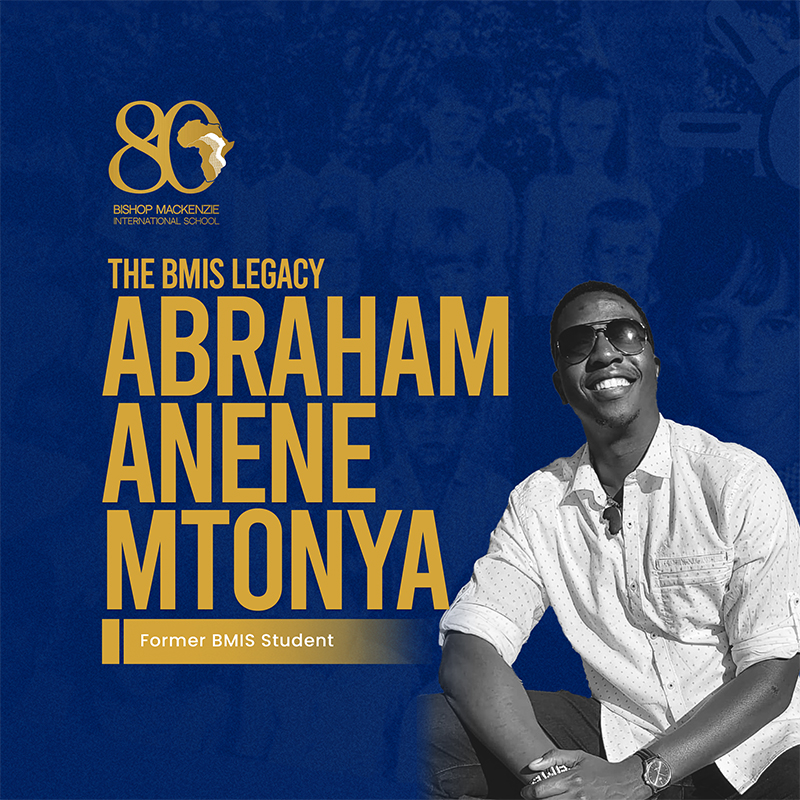
Can we start with your name and the years you were at Bishop Mackenzie?
Alright. Well, hello. My name is Abraham Anene Mtonya, and I was at Bishop Mackenzie from 1994 until the end of 2002.
What brought you to Bishop Mackenzie in the first place?
Well, my late father, Lieutenant General Mtonya, was serving as Malawi’s High Commissioner to England before 1994. When there was a change of government, and Bakili Muluzi became the first democratically elected president, my father was brought back to Malawi. Until then, we had been fortunate to have an international education, living in places like Kenya and England. When we returned to Malawi, my parents wanted us to maintain that international education, so instead of switching to the local MSCE system, we stuck with the IGCSE curriculum. Since we were based in Lilongwe, the options for schools were Kamuzu Academy, St. Andrews, and Bishop Mackenzie. My siblings and I went to Bishop Mackenzie, since it was the closest to home.
What was life like as a student at Bishop Mackenzie? What were your classes like, and was there a lot of diversity?
When I first arrived, diversity wasn’t something I thought much about. Having lived abroad, I was used to being one of the few black people in class. At Bishop Mackenzie, it was mostly foreign nationals—expats and their children—since the school was initially for those groups. Over time, it opened up to local students, and the diversity grew. There were kids from all over the world—Portugal, Italy, Spain, France, Germany—and local Malawians too. I had friends from everywhere, and there were times when I was the only black person in my class. But I didn’t think much of it at the time. The teachers were mainly foreign, while local staff were hired for roles like custodians. I think some people would be more race-conscious, but for me, it was just another day at school. I fit in with any group, whether my white friends, Indian friends, or black friends.
How would you compare a day in the life of a BMIS student then and now?
I haven’t been back to Bishop Mackenzie since about 2014/15, but I remember when they started introducing the IB program. Back then, we did IGCSEs and A-levels.
We had computers, and I remember learning to type on Windows 95, playing computer games in the IT room with those big clunky computers that were not as articulate as they are today, but it was fascinating to learn how to type on a computer. But also maintaining the art of handwriting. And I remember, writing with pencil and learning how to write in cursive and having the handwriting exam. That was something that they would teach or they would offer, so that you could graduate from writing from a using a pencil to writing with a pen, and only a few people were good at it enough that they could trust them with a pen.
In primary school, the headmaster was Mr. Tucker, and when I moved to secondary, Mr. Mundy was the head. We had Friday assemblies, and I remember Mr. Tucker lighting a candle during assembly to keep our attention. I became a house captain for Viphya, and we had three houses in primary school: Zomba, Mulanje, and Viphya. Secondary school had Kasungu, and I forget the other one, but we lived for inter-house competitions. I was very athletic and loved competing in swimming, athletics, and other activities. We also had events with other schools like St. Andrews and Kamuzu Academy. It was a great time, and there was a real sense of school pride.
What are some of your happiest and saddest memories from your time at BMIS?
One of my happiest memories was winning the first Bishop Mackenzie Pop Idol competition. It was inspired by shows like American Idol, and I was just 14 when I won. Another big highlight was winning the public speaking competition. I competed in different categories—standard six, best improvised performer, and best overall. It was a big moment for me. Also, I was part of the school play where I played Fagin in Oliver Twist, which sparked my interest in acting. Those were the times I truly felt like I was living my best life.
What have you been up to since you left Bishop, and how did the school cultivate the talents, and values you have now?
First of all, I guess, big shout out to Mr. Allen, Ms. Philby Mrs. Rickey. They were both my music teachers and Mr. Allen was the acting teacher.
Mr. Allen was in charge of the secondary school theatre productions. He reached out to me in primary school and asked if I wanted to act in one of the major productions in secondary school as Reverend Sykes from the play To Kill a Mockingbird. Which for me felt like, oh, what an honour. Because I was in primary school as a kid, why are you asking me to play? But he believed in me that much..
So I left Bishop in Form Four (Grade 10), and moved to the International School of South Africa (ISSA) where I got to continue acting. I eventually moved to the United States, partly because I wanted to continue acting. And I knew in the back of my head that if I still wanted to make it to Hollywood, I needed to move to America. I got accepted to Arizona State University where I pursued my bachelor’s degree in theatre.
I moved to California for the very first time in 2012, after graduating with my bachelor’s in theatre. In California, I acted a little bit, acting in a few TV shows and then I got my master’s degree in theatre afterwards at University of Houston in Texas. I eventually toured the country doing Shakespeare festivals and got to act with some great, great names in, in the theatre world.
Currently, I’m a host for a children’s program called the NED shows. NED stands for Never Give Up, Encourage Others, and Do Your Best. It’s an animated show that happens live on Zoom for primary and elementary schools around the country and across the globe. I get to do that full time. Of course, I want to get back into acting, but
I think the biggest thing was everyone was like, ‘Oh, acting is a real profession? Can you survive off of it? What do you really want to do? You should be a doctor, lawyer, you know, accountant’, the usual things our parents tell us in our, in our African households.
But I am an artist, and my art pays for my life and I get to do that, what I love. And not everyone can say they have moved from a different country to the United States and became a resident based off of their acting and I do that. That’s my biggest achievement, that I believed in myself from the age of 11, that I’m going to move to America, live in Hollywood, be an actor. I’m doing that now. So very happy.