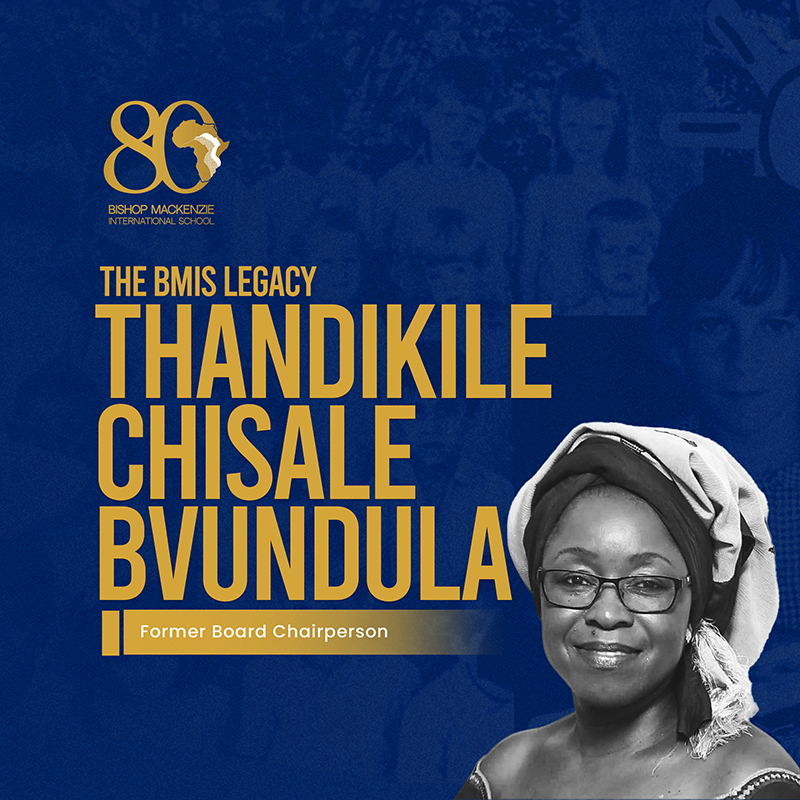
What is your name and what years did you serve on the BMIS Board?
My name is Thandikile Chisala Mbvundula and I served on the BMIS board from 1994 to 2002. I was the chair of the board for 8 years.
Being on the board isn’t something many parents consider, why did you decide that you wanted to be on the board?
I believe that when you’re looking at the school, especially when your children are there, one wants to be able to contribute in whichever way you can. And I was approached to consider serving on the board. Being active in the community in many other aspects and having served on other boards as well and in addition to seeing some of the issues that we felt needed to be addressed at the school at the time, I was happy to serve with the board. It’s 1 of the things you do, I think sometimes in life, you can’t always wait for everybody else to do things. You can complain on the sidelines – If you feel that there’s something you have to contribute, and you have the means to do so, I think it’s important to do it.
You were the first chairperson of the board, did that come with a lot of pressure?
Yes it did come with a lot of pressure, but it wasn’t what I would call undue pressure. I think we had a good mix in terms of the members of the board and the commitment. Because when you’re serving on the board, I think the commitment of your board members is important. And had a very committed team. We had members from different parts of the community that were represented. Occasionally in engagement with various other stakeholders, you had those that felt that it should be a man that should be addressing them, but I think they kind of get used to it when you’re professional about what you do.
Can you speak a bit more about what it was like being the 1st woman on the board? And were there any other women on the board, as well.
No, there were no other women on the board. Not until I left. There were no other women on the board, so, in fact, when I left, I think then it became an all male board. You know. At the time that I stepped down as chair, I handed over to Mr. Lino Passoni, he was the one that was elected the chair. And then I had stepped down completely because my other commitments didn’t enable me to make myself as available with as much commitment, so I felt better to resign. And though it was another gentleman that replaced on the board at the time.
And it was always a challenge in terms of, I mean they’re always challenges, but I think sort of the key issues that we had was basically the demographics of the school. And I think it’s always been a challenge in terms of the fees that which demographic pays which fees and that has always been, was always a very difficult
issue to deal with. And I, you know I’m not sure how it’s dealt with now, but I think it’s it’s always been a contentious issue, and I’m sure it continues to be. But one would wish that…there’s a way that a balance be struck.
So what were your aspirations when you joined the board? What were the changes that you thought you could make and what were the changes that you think you did manage to make?
I think the changes we made were actually pretty major because initially it was only Bishop Mackenzie Primary School and then there was the addition of the Secondary School. I think there was a concern because of the large number of international students that attended Bishop Mackenzie that there was no high school, and they weren’t sure whether to choose A Levels or International Baccalaureate. And the IB curriculum was the one that we chose because there was no IB in the country, so we established the 1st IB School in the country.
The demographics again of the students of the school who came from non-British countries, because its predominantly A-Levels that were available at St. Andrews and Kamuzu Academy and some of the other schools. If you’re going to British universities, they do look at A-Levels as a prerequisite, but in other schools in the United States and Europe they use the IB system so that’s one of the major things that we managed to get.
Was it something that you had to debate back and forth? Or was it something that was just kind of agreed that we definitely need to be an IB School?
We definitely had to do our research. I mean, decisions like that are major decisions. You can’t sort of just say one person makes the decision, and we all say, Yes, that’s what we do. We have to look into. We have to do the research. We have to be sure that it will serve the best interests of the community that we serve.because we had people from so many different countries that you know in attendance, and they were not necessarily going to be going to England, that we would better serve the community if we made a debate. You know we we put a more neutral qualification at the, you know, for for our high school.
One of the concerns we had when I first opted to serve on the board is when we were under the designated schools board. Being in Lilongwe so far from the center, because a majority of the DSB school are in the Southern region. I think you had Sir Harry Johnson, St. Andrews primary, St. Andrews secondary Hillsview, and then way up about 300 kilometers away you had Bishop Mackenzie. So we didn’t always get as much attention in terms of meeting our needs as we required as a school, you know, because what would happen is all the fees, and the revenue would be aggregated at the DSB, be centralized, and then they will redistribute it for the development of the schools, and we did not feel that we’re getting adequate attention in that regard.
So it would be like, oh, the library needs upgrading, and you find it’s becoming dilapidated, the school. The quality of the box is not up to standard, and it would go through a very lengthy process to try and get that addressed. And so we just felt that we needed to have administration closer on the ground to to the school, so that we could more quickly respond to the requirements of our school.
While we’re on the subject of the Designated Schools Board, could you give us a bit of background as to what that was?
I would probably not be the best person to give that background, but I will try. The Designated Schools Board was a governing board for all of the international schools that were established and this is from Independence
Interestingly enough, and this is somewhat controversial, but initially no non-white people were allowed to attend the designated schools. So no person of color was allowed to.
But in actual fact it was in probably early, 1970s, my brothers were actually the 1st non-wide people to attend Saint Andrews. And for them to attend, my father had to ask permission from the Head of State from Kamuzu Banda for them to be allowed to attend.
I think the question at the time was, “would they be able to cope?. At the time, our family was coming in from back from the cohort of the 1st set of diplomats that Malawi had from independence. We had been attending international schools everywhere went. So in coming back, my father wanted that us to continue with that curricula, that education, and came back and found the situation where no there. And so he actually passed permission, and permission was granted by by the President on condition that reports went back, and as to their performance to see how they managed, how they were integrated. And once the president was satisfied that yeah they seem to be coping okay, that’s when it was opened up
- What did they mean by coping like in terms of their performance?
I think it would be everything. It would be the performance. It would be their social engagement, integration. I mean, those were the days when there was a lot of racism in the country. Even through my years at St. Andrews, I think we were fortunate to have an Irish deputy headmaster, and the 1st thing you were told when you came to school. When we came into school, our 1st assembly, we were all very clearly instructed nobody was allowed to insult anybody because of their race or any other- but that one particular. Because you had a lot of people who came from South Africa and it didn’t sit well with them.
But the other hand – which was interesting to me – I’m still in touch with all of my classmates, and trust me that that’s that’s from a very long time ago. I met one of my classmates at the University of Cape Town (UCT) and I was the only black person in my class all the way till I’ve finished. Because my brothers were the first, they were also had that sort of situation. But it wasn’t something that phased me, I mean, I engaged very well with my classmates. And I remember meeting one of my old classmates at UCT, in South Africa, and we went for lunch. In fact, I stayed for a couple of days after that. And I mentioned that I was the only black person in our class. She says, “were you?” and I guess she’s somebody who’s interesting because she’s color blind, it didn’t dawn on her, it wasn’t something that she actually thought about. But it’s like years later, she’s like “I didn’t realize.”. But I have a lot of very good friends and as I said, we’re still in touch till today.
One of them, we were in the same class, our 1st born children were in the same class, our second born children were in the same class. So we go back a lot.
I have twin daughters and we made a choice to have them in to different classes, for each of them to develop independently of the other and not being overshadowed. So one of them was in the class where she thoroughly enjoyed herself, she had a couple of other Malawian students. The other one was in a class where she was only Malawian student and she didn’t realize it until somebody pointed it out to her. I think this was probably by the time she got into standard 4 or something. But you know initially she was just another student.
I mean, I went from being the only black person in an all-white co-ed class, to being the only woman in an all-black class. When I was doing my A levels, I was only woman. It was just me in a class of all men, but this is now all Malawian. I went from there – because of a degree that I took – to being the only black woman in the whole faculty of engineering in the University of Sheffield. So there were no other. It was at a time when not many women were doing engineering. So we had British girls, one Chinese girl and me. It wasn’t until I got into my 3rd year, finally, that one other Nigerian girl came into the faculty of engineering. So you get into these spaces. Then I go into a company for the next 8 years where I was the only woman, anyway. So yeah, you get into these spaces. It doesn’t phase me, I don’t think about it, I’m a professional, so if I can do the work, I can do the work.
You were the only woman in the BMIS board at the time, and one of 2 Malawians on the board as well. Di you feel like you need to prove yourself?
Well, the thing about it is, I’ve always been a professional about what I do and everything I do, I do to the best of my ability.
But then, of course, I realized that when I went into my professional workspace. I didn’t think about it because I’m not looking at me. I’m going there as a professional, and I’m going to deliver a service or whatever. But people look at me as you’re a woman and will you know what you’re talking about? But I often don’t listen to that part of it, because I’m going there, I do know, I know what I’m talking about, and if they’re unconvinced they get to a stage where they realize. Okay, she does know what she’s talking about and they park the fact that I’m a woman.
So you were a student at St. Andrews, and your brothers were students at St. Andrews as well.
First black head girl at Saint Andrews, as well.
You have a lot of firsts…
I do have a lot of firsts. That being the case, I may as well add that I set up the 1st commercial email service in Malawi, and the 1st woman owned ISP in Africa.
I mentioned that I was retired, running my restaurant and I’m actually currently the chair of the Malawi Space Agency Taskforce. So I’m setting up the Malawi Space Agency, we’ve been coordinating this project for about a year. Then in February, my name was put forward to the African Union, because the African Union is setting up the Africa Space Agency. The governing Council of the African Space Agency is the Africa Space Council. and I was elected as a Vice President. So I am actually Vice President of the Africa Space Council which is the governing body for the African Space Agency.
Were you still Chairperson of the boards when the designated schools board was dissolved? Or what exactly happened?
Well it wasn’t dissolved, but I mean it was a decision that we made as the Board of school. So we we were the 1st school to come out of the designated schools board. Of course it was very controversial. It was a bit of a battle doing that because, well, nobody had ever done that before to start off with. And in terms of revenue, Bishop Mackenzie, because of its international student body: your students of diplomatic parents were paying in dollars so that was quite significant rather than paying in Kwacha. Because we had 3 categories, at the time. We had the diplomatic, the non-Malawian taxpayers and permanent residents (which was people who own businesses, but non-malarian) and then Malawian passport holders. So you had 3 categories for a 3 tier fee structure.
At the time, as I said it was a challenge, but we really needed to get the management of the school for the development of the school. The school was beginning to stagnate in terms of response to upgrading particular areas
So was the decision to leave the designated Schools Board a choice that your Board had made?
Our board made that choice, so that transition happened while I was still chairing.
Are there any specific accomplishments or milestones that you’re proud of in your time as the chairperson?
I think setting up the IB is one in particular but also- . And I, and I know that there have been debates about the independence and the governance of the school. I haven’t sort of followed it, because I travel. I was out of the country, and I think I was hearing bits and pieces about it when I came back about sort of the issues about it being private. Because designated Schools board was set up by the government because these schools were built by the government. So ideally, they’re actually government owned but for the international community in the country, that’s kind of how they were set up. That’s kind of how the designated schools board was set up.
So I think at the time that I was chair of the board, one of the things that we implemented was a fairer fee structure, I think things have since changed.
But I also say, look at the school and look at the quality of the school. The ways it’s being maintained now. I think a lot of that is because we were able to become an independent school and be more responsive to developments that need to happen on the ground. ThatI think gave us is something that I think was was very important. Because things like the library. You could see they were in a poor state and not being upgraded, and so on. But I look at the school today, and I think that it’s done well, it’s done well. That’s from an outsider’s point of view, because, of course, I no longer have children there. If anything, if my children were here, I’ll now have grandchildren, which is absolutely bizarre. But yes.
You were the chairperson of the board when Bishop Mackenzie, moved from being owned by the Malawi Government to being independent. What was what was that
It was actually quite a complex legal process to do that, and there had to be negotiations with government, as well as the designated schools board for that to happen. But I think from my understanding now is, I think we were kind of seeking clarity as to really who has the overall mandate over it. The thing is that all of the infrastructure there, it’s all been built by government. It’s government that builds all of that and put the infrastructure in place. So I think there needs to be going forward, there needs to be some sort of agreement, issues have been that may be under dispute? I don’t know how the property has been.
Because the designated Schools Board was a custodian, and we similarly as a board were custodians because we didn’t pay any money for for the infrastructure. So we couldn’t say it’s completely, privately owned, we’re custodians. But if they’ve been changes since then that’s something that I am not aware of.
No, I mean—I think it was… Again, I think it was an honor to have served as Chair of the Board for the school. We built up the capacity of the board, we had board training, and at the time, we did the best we could. And as I said, when I look at the school today, it’s impressive to see how much it has progressed.
One concern for me is the issue of access—ensuring that a school of this quality remains accessible to both local and international students. I think that’s a very important aspect that needs to be considered. It would be good for the school to explore ways to address this, because right now, access is largely restricted by the cost of attending. The affordability factor makes it difficult for the local community, particularly those who don’t earn in foreign currency. And as the Kwacha continues to devalue, it becomes even more challenging. In a school with both international and local students, there should be a balance. Moving forward, I think it’s crucial to ensure that the school remains as inclusive as possible. There is a mix, but more steps can be taken to accommodate a broader section of the community while maintaining the quality of education.
For example, I know there were concerns when I was Chair of the Board and chose to send my daughters to Kamuzu Academy for secondary school after they had completed primary school at Bishop Mackenzie. There was an uproar—people were asking, “How can she be Chair of the Board when her children are going to Kamuzu Academy?” At the time, they assumed I didn’t have any other children at the school. But I did—my son was still at Bishop Mackenzie. Even then, people said, “But she still has a child here.”
The reason I made that decision was that I felt certain elements of the curriculum—particularly STEM subjects—weren’t as strong at the time. I hope that has since changed because STEM education is very important to me and my children. That’s something I really hope the school continues to strengthen.
Over the years, I’ve also heard from many of my former classmates, and we often reflect on our education. Many of them say things like, “Why didn’t we learn about our country’s history?” or “Why didn’t we learn practical life skills when we were in school?” I think those are important things to consider. It’s unfortunate that students can go through an entire education system in a country and graduate without really knowing much about it. That’s something I believe the school should look into.
In today’s globalized world, things have changed. In the colonial era, it may have been different, but now, when students go to university, their identity and connection to their home country matter. Many international students end up feeling like what’s known as “third-culture kids.” I’m not sure if you’ve heard that term before, but it refers to children who grow up outside their parents’ culture and don’t fully belong to either their home country or the country they were raised in. This can make it difficult when they eventually return to their country of origin. I’ve seen this happen with many of my former classmates.
These are formative years—primary and secondary school are crucial to shaping a person’s identity. You don’t always realize the impact until you’re an adult. I can say this from experience because I, too, am a third-culture kid. Even though I ended up going to St. Andrews, I also attended international schools in different parts of the world. And when you come back, you don’t quite fit into any specific category.
That’s why I believe learning about the country you live in is important. It helps students feel more connected, no matter where they come from.